


The Alto Matese Inland Area, made up of 17 municipalities in the province of Caserta, is characterised by depopulation, difficulties in accessing essential services and infrastructural isolation.
The Inner Area covers a total area of 543.49 km2, with a population of 36.323 as at 31/12/2024. The area is entirely classified as ‘peripheral’ according to SNAI, with an average population density of around 67.7 inhabitants per square kilometre, with large internal differences between the most accessible and mountainous municipalities. The territory is characterized by a mountain environment of high natural and environmental value, strongly identified but at the same time marked by structural difficulties: isolation, demographic ageing, youth unemployment, marginalisation of essential services (health, education, mobility). These problems are accentuated on the mountain side (Letino, Gallo Matese, Valle Agricola, San Gregorio Matese), while the foothills (Piedimonte Matese, Alife, San Potito Sannitico) represent the fulcrum of services and socio-economic relations of the territory.
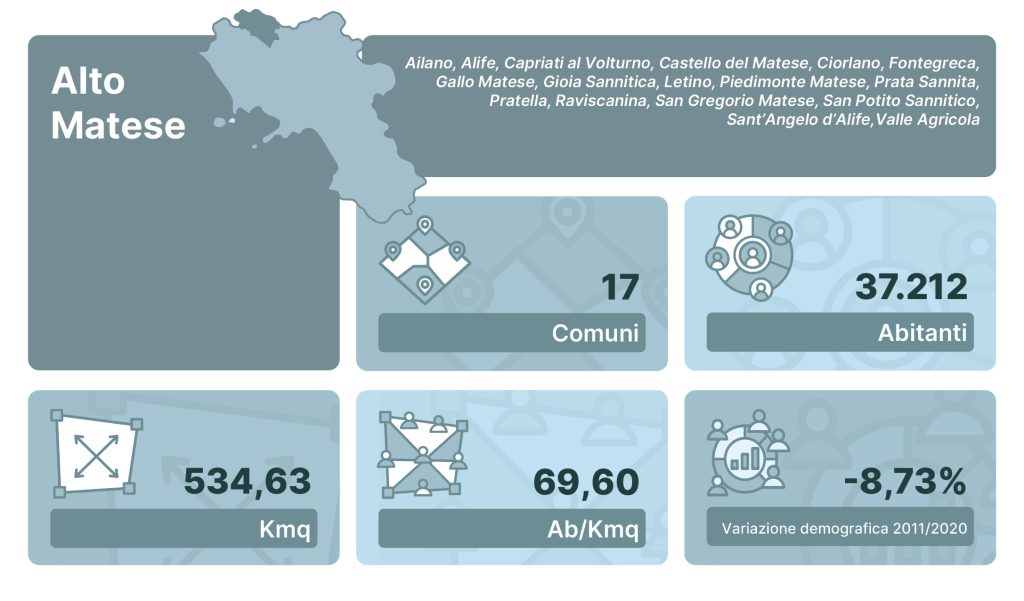
Demographic dynamics are negative, with an overall loss of 9.47% population between 2012 and 2022. Some municipalities recorded particularly significant declines, such as Gallo Matese (-23.2%), Valle Agricola (-21,5%) and Raviscanine (-16%). Only San Potito Sannitico showed a slight increase (+0.82%). As of 31/12/2024, the total population is 36,323 inhabitants over an area of 543.49 km2, with an average density of 67.7 ab/km2.
The situation is exacerbated by a strong generational imbalance, due to the flight of young people and the ageing of the resident population. The internal road network is fragmented and partly obsolete, especially in the mountain areas (SP83, SP89, SP331, SP273). In many areas the connections are subject to critical issues related to landslides, restrictions and lack of maintenance, with negative impacts on school, work and tourist mobility.
Today, mobility on road is mainly entrusted to private vehicles; Inter-municipal public transport is weak and poorly integrated. The nearest railway connections are to Vairano-Caianello and Venafro (FS Silver), with limited direct connections to the centres of the area. The 64.7% of the citizens interviewed considered that mobility difficulties are an obstacle to development and 74,4% He sees it as a brake on tourism. The main problems perceived concern the road holes (74,5%), the tortuosity of the routes (55,3%) and the presence of wildlife (36.1%).
Here is the preliminary strategy "Alto Matese" to be adopted DGR 62_2026



 English (UK)